As an Amazon Associate, I can earn from qualifying purchases. Learn more.
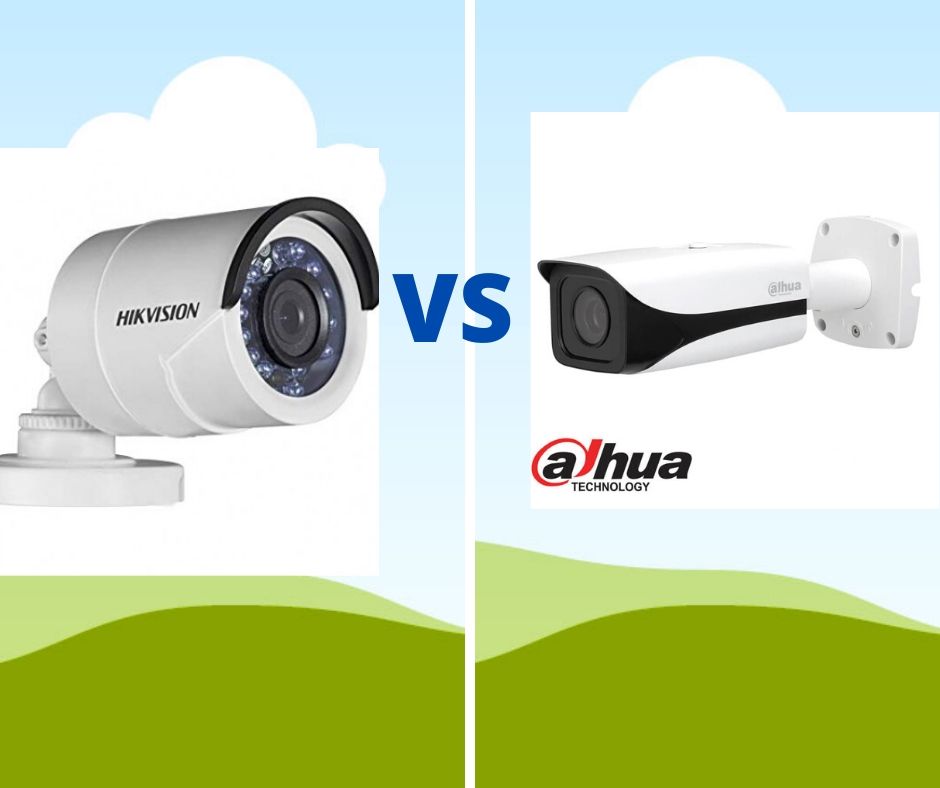
To compare HikVision vs Dahua is just like paralleling Amazon with Walmart. As companies, they share quite a number of things, and so are their products. The two even are always amongst the list of the top video surveillance brands, owing to their good reputation and large customer base.
Therefore, of the comparisons we have done recently, this one will be the most interesting of all. Even so, we will do it in detail so that you can make the right choice when the time comes. Security is a vital necessity in our everyday lives, and that’s why governments also have CCTV cameras almost everywhere.
So, for your home or business to thrive as you want it to, you also need extra eyes to keep watch while absent. And luckily, our two companies have some of the best solutions for that.
Here is a table that summarizes the likeness and differences between Dahua and Hikvision security cameras.


Overview of HikVision and Dahua Security Cameras
As we just said, paralleling HikVision vs Dahua is more than funny due to their many similarities. With one on the front page, the chances of coming across the other are 99%.
From a recent report, analysts hinted that the two Chinese makers take at least 40% of the global video camera market. At the time, the U.S. government had not yet passed the NDAA Act. Hence, the share must be lower now that the Trump Administration has banned the two brands in their Federal bodies.
Despite the government ban, though, Forbes highlights that the tech from the duo is still in wide use across America. In 2019, as many as 200,000 Dahua cameras and 15,000 HikVision.cameras were in use.
From the figures, you can see Dahua has the largest American market, with more than 10x that of its competitor. This is so as the brand serves both the consumer and professional market, plus they have more OEMs.
With OEM, we simply mean other companies [like Amcrest and Panasonic] who re-brand Dahua cameras and sell them under their name. Thereby enabling the original maker to access more operation base
With HikVision, things are quite different as they largely serve the professional market. The majority of their cameras, however, do fit the DIY space. Hence, you can get any of them, including the EZVIZ IP cams, and easily install on your property all by yourself.
Comparing HikVision vs Dahua Capabilities and Features
Image Quality
Overall, there’s no much to compare here. The two security providers serve their clients with systems that have the latest tech to ensure they are satisfied and optimally. They both have a wide range of camera brands, with some even featuring an 8MP sensor that delivers clearer and sharper images.
Even with that, Dahua has a wider selection that comes with superior optics. Furthermore, the provider mostly use True WDR while its rival rely on digital WDR. Of course, the two are spectacular technologies, but the True WDR produces better quality images in dark areas.
As for the nighttime, Dahua does have the cutting-edge starlight night vision that records colored images in bright and low-light backgrounds. On their end, Hikvision does have such a selection as well, but theirs use the Darkfighter technology, which is also efficient [particularly after the recent upgrade].
Smart Features
For this one, we will focus on the video content analytics that helps enhance the general performance of a surveillance camera. Our two companies offer systems with these inbuilt video tech. Hence, you won’t need to make an additional investment.
Some of these video features include motion detection, facial recognition, intrusion alerts, plus video tampering detection. The brands even have cameras that can detect and send alerts triggered by a sudden increase in sound.
Ease of Use
Technically, there is no need of comparing Hikvision and Dahua for this one. The former is genuinely the winner, starting with the plug-play solution and user-friendly software that even doesn’t need techie- skills.
For Dahua, the client software is quite crummy and requires you to follow some silly prompts to set up. Hence, not very interactive as we would have wished.
Pricing
Hikvision and Dahua offer affordable security cameras, with multiple models even costing less than $100. Nonetheless, Dahua cameras are fairly cheaper and this is the reason most people consider them.
From the table, you can see Hikvision and Dahua share quite a lot on the specifications. For the smart home compatibility, they both have one or two products that you can use with smart home devices like Alexa.
Also, the brands do have multiple security cameras that are ONVIF compliant. But as of January 2020, the non-profit organization confirmed that they have suspended the two Chinese tech giants. The move came after the U.S government blacklisted the use of the pair [plus their OEMs] in Federal bodies.
Better enough, though, Hikvision and Dahua offer an affordable selection of CCTV cameras. Hence, the reason, thousands of Americans are still considering them for their security demands.
Here are four products you can check out during your next shopping…
Hikvision DS-2CD2032-I Bullet Network Security Camera
- 3 megapixel High Resolution
- Full HD 1080p Video Output
While it appears simple before the eyes, this bullet camera is truly high performing. It has a 3MP image sensor that captures bright and sharper images than the standard 1080p Full HD.
The CCTV camera has a 76° viewing angle, plus digital WDR to balance lighting in dark and bright areas. It has a minimum illumination of 0.07 lux and the IR LEDs enable visibility up to 100ft in darkness.
As a network camera, the piece is very easy to connect to the NVR with an Ethernet cable. And you can also use it as a standalone camera using a PoE injector or Switch.
Key Features:
- The bullet camera has a 3MP sensor that delivers crystal images that ate rich in details
- It has a 76-degree viewing angle and a minimum illumination of 0.07 lux
- Features a superior night vision of up to 100 feet
- Uses the PoE connection, which is straightforward to set up and use
- Can send motion and camera tampering alerts
- The security cam is IP^^ weatherproof to allow both indoor and outdoor use.
What we don’t like about it:
Although it has multiple goodies, the camera uses H.264 compression, which tends to consume more bandwidth and storage space. Also, the system has no support for audio functions.
HikvisionDS-2CD2142FWD-I Dome Network Security Camera

- Features: Day Night, Waterproof, Plug and play, Remote Access, Dual Stream, PoE, Motion Detection
- Maximum SD Card Support (GB) :128 . Sensor: CMOS;
If you feel 3MP won’t be enough for your needs, this dome model can make a better option. It captures 4MP images that are about 2x clear than 1080p HD. Hence, you can even zoom distant objects without drastically lowering the clarity.
The security camera does have a True 120dB WDR and 3D DNR technologies to ensure you enjoy quality monitoring. It has an outstanding night vision to allow convenient 24/7 surveillance and an inbuilt microSD card to keep recordings when the internet is down.
As for the connection, this surveillance cam uses PoE technology. Hence, you can use it as a standalone or an add-on piece to your existing NVR station.
Key Features:
- The camera delivers bright and crisp images, with vivid details and clarity
- It captures objects located up to 100 feet in darkness
- Uses true WDR technology to balance e image quality in varying lighting conditions
- Comes with a built-in microSD card slot for local recording
- Can support third-party ONVIF compliant devices and software
- It’s sturdy and IP66 waterproof to last longer
- The security camera can offer discreet monitoring indoors
What we don’t like about it:
Similarly, the IP camera uses a lower H.264 video compression, which can lead to the consumption of more storage space. Also, it neither supports one-directional or two-way audio.
Dahua HDW4631C-A Indoor Dome Surveillance Camera
- 1/2.9” 6Megapixel progressive scan STARVIS CMOS,Low-light effect is good, high-definition images
- H.265&H.264 triple-stream encoding , 20fps@6MP(3072x2048), 25/30fps@4MP(2688x1520) , Smart detection...
This one now has a higher resolution than the above two models from Hikvision technologies. It has a 6MP sensor that allows easy reading of license plates of vehicles at a 50-60ft distance. The dome camera is a Turret model that has two lenses with a minimum illumination of 0.002 lux.
Also, different from the above models, it has a built-in mic to record video with audio and dual H.265/ H.264 video compression technology. Thereby presenting you with an option to enjoy faster seamless streaming and longer recordings in your NVR station.
Key Features:
- The IP camera delivers crystal HD videos with audio
- It supports low-light recording at a minimum illumination of 0.002 lux [in color]
- Has a superior infrared night vision of up to 100 feet
- Includes smart H.265 video codec to maximize bandwidth and storage consumption
- Can work as an add-on or standalone camera
- The security camera advanced motion detection and remote viewing
What we don’t like about it:
The single downside with this camera is that you can only hear what the people on the other end are saying. It doesn’t support a two-way talk, which can be very useful in communicating with relatives and scaring away intruders.
Dahua Pro A52AB62 Bullet HDCVI Security Camera
- 1/2.9” 6Megapixel progressive scan STARVIS CMOS,Low-light effect is good, high-definition images
- H.265&H.264 triple-stream encoding , 20fps@6MP(3072x2048), 25/30fps@4MP(2688x1520) , Smart detection...
The product is an add-on camera that you can use to replace or upgrade your existing analog BNC models. It features a 5MP STARVIS sensor that records crystal images in both bright and low-lighted backgrounds.
The surveillance camera has a smart IR LED that allows the capturing of objects located up to 131ft away. It also has an inbuilt mic to record audio and make your streaming less boring.
Key Features:
- The bullet camera is for use with an HDCVI DVR station
- It has a 5MP Starvis image sensor that delivers crisp HD pictures, rich in color and clarity
- Features True WDR technology to allow quality recording in varying lighting conditions
- It has an excellent night vision, with up to 131ft range
- Comes with a built-in microphone to enable recording of footage with audio
- The camera has a robust IP67 waterproof shell to allow outdoor use.
FAQ
Is Dahua better than hikvision?
Well, the two security brands are exceptional as they offer affordable devices, with the latest technologies for optimal monitoring. Even for image quality, the two already have 12MP cameras, although, they’re yet to introduce to consumers.
From an honest opinion, though, Dahua is better than its peer on pricing and the use of optics. The provider has many cheaper cameras and also it uses advanced starlight technology to deliver clearer images in low-lighted environments.
Is Dahua a good brand?
Overall, yes it’s. As we have just said, the brand offers less expensive cameras that have advanced technologies, including smart starlight technology.
Which is the best Hikvision camera for a home?
Just like Dahua, Hikvision is an outstanding provider of security solutions, and, actually, the number one in video surveillance technology.
As for their best camera for home, that question is quite vague as the answer relies on several aspects. It depends on personal preference, budget, and also where you want to monitor.
If you want a camera for indoor monitoring, for instance, a dome model like the Hikvision DS-2CD2142FWD-I is perfect. It delivers quality HD images and also its sleek design won’t compromise your interior décor or easily arouse suspicion.
Conclusion
As you can see, comparing Hikvision vs Dahua can, well, compromising your judgment call when buying. Many are the things the two share in common, including product specifications and the mission to offer affordable security solutions.
As for the ongoing security concerns, we believe no CCTV camera [particularly network supported] is safe or privacy concise. At some point, they all will send data back to their manufacturer’s servers.
So, whether the Chinese make or not, banned or not, it’s upon the end-user to find a better way of not leaking data to outsiders. And the best way to do this is to build an impenetrable hardware firewall.
Similar Article: